
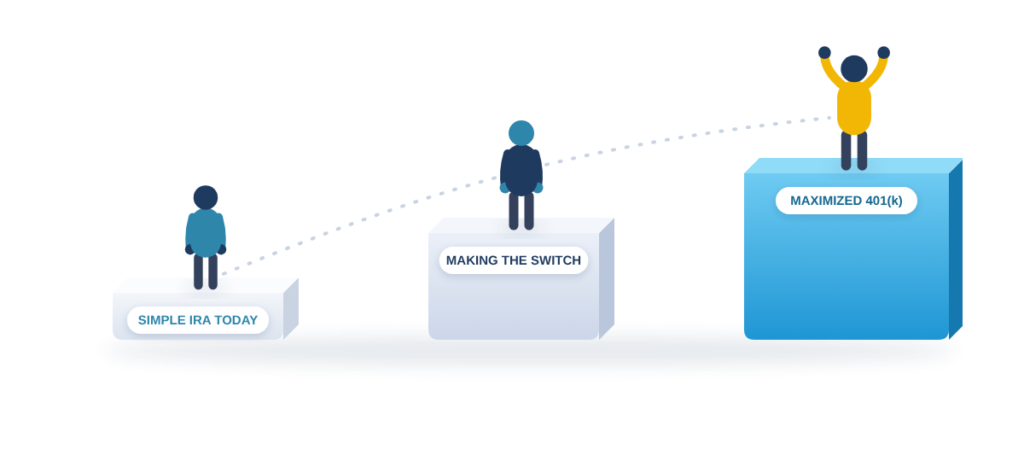
Thanks to SECURE 2.0, switching from a SIMPLE IRA to a 401(k) is easier than it used to be. Employers can now replace a SIMPLE IRA with a 401(k) at any point in the plan year, and — if the new plan is designed as Safe Harbor — employees can roll their balances into the new plan even before completing the SIMPLE IRA’s standard two-year waiting period. For business owners who’ve outgrown their SIMPLE IRA, that flexibility removes one of the biggest hurdles to making the switch.
For business owners and financial advisors navigating this decision, understanding the key differences between these two plan types — and knowing when and how to make the switch — is essential.
A SIMPLE IRA — Savings Incentive Match Plan for Employees — was designed for small businesses with 100 or fewer employees. It’s easy to set up, has minimal administrative requirements, and requires employers to contribute either a 3% matching contribution or a 2% non-elective contribution for all eligible employees.
While these features make the SIMPLE IRA an accessible starting point, the plan type carries contribution limits and design restrictions that can meaningfully impact high earners and growing businesses.
For business owners focused on maximizing their own retirement savings — or advisors designing plans around highly compensated employees — these differences are significant. A 401(k) offers plan design flexibility and higher contribution thresholds that a SIMPLE IRA simply cannot match.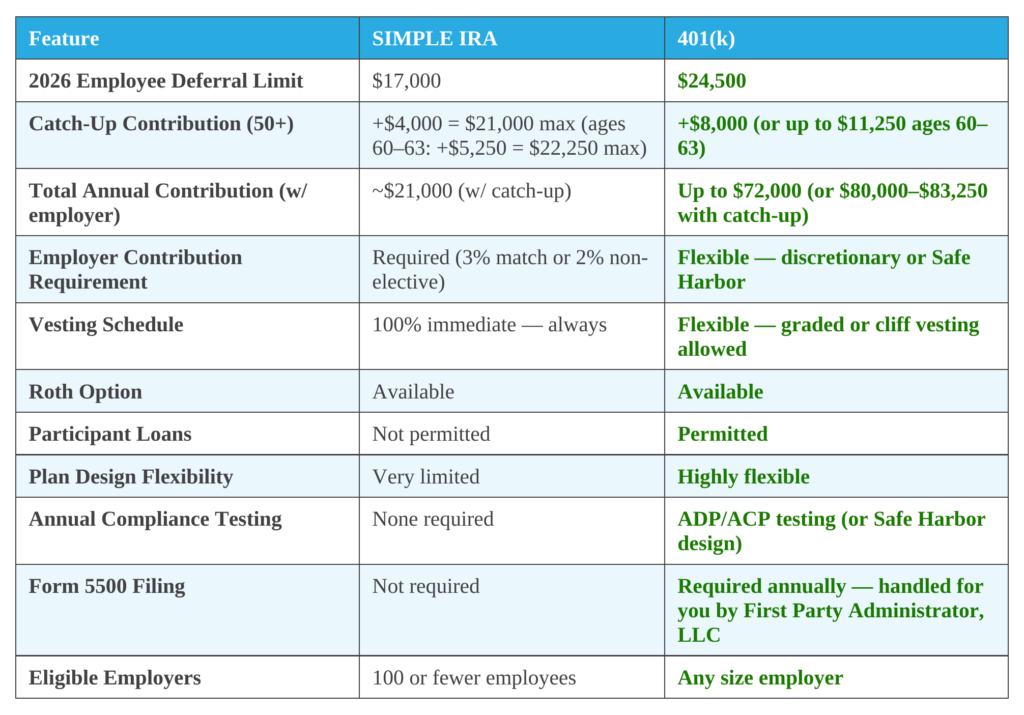
Not every business will benefit from making the switch, but these are common indicators that a 401(k) conversion conversation is worth having:
If any of these apply to your business or your clients’ plans, a conversation with your TPA is a logical next step.
A SIMPLE IRA-to-401(k) conversion involves several coordinated steps, but the process is more manageable than many business owners expect. Here is what is involved:
To illustrate the impact: a 55-year-old business owner currently maxing out a SIMPLE IRA contributes approximately $21,000 per year (the 2026 limit including catch-up). In a well-designed 401(k) with Safe Harbor provisions, that same owner could contribute upwards of $72,000–$80,000 annually — factoring in employee deferrals, employer matching or profit-sharing, and catch-up contributions. Add a DB/DC combo plan and the numbers increase further.
The contribution difference between these two plan types is substantial. For owners focused on retirement savings, that gap compounds significantly over time.
If a SIMPLE IRA-to-401(k) conversion is even on your radar for 2027, now is the time to start the conversation — not December. The termination notice deadline is November 2nd for a January 1st effective date, and getting a well-designed 401(k) in place takes coordination between My Benefits as your TPA, your financial advisor, and sometimes your payroll provider.
At My Benefits, we’ve walked many business owners through this process — and we’ve seen the difference that a well-timed, well-designed conversion can make. Tailored. Proactive. Accurate. That’s not just our tagline. It’s how we approach every plan we touch.
A SIMPLE IRA-to-401(k) conversion isn’t one-size-fits-all, and the details—plan design, timing, Safe Harbor provisions—make all the difference. At My Benefits, we work side-by-side with business owners and financial advisors to build a 401(k) tailored to your goals, not a template.
Thinking about making the switch for 2027? Reach out to your dedicated TPA team at My Benefits today for a complimentary plan review—before the November 2nd termination notice deadline sneaks up on you. Let us help you simplify the conversion and strengthen your plan—together!
Your retirement plan questions answered, in plain English, by an expert. Use the form below to ask our retirement plan experts your question.