
Every November, the IRS hands plan sponsors, advisors, and savers a fresh set of numbers to plan around for the year ahead. On November 12, 2026, the IRS released Notice 2026-66, setting the cost-of-living adjustments for 401(k), 403(b), 457, SIMPLE IRA, and SEP plans for 2027 — and most of the key limits are moving up again. Here’s what’s changing, what’s staying the same, and what it means for your plan in the new year, plus our full 2027 Plan Limits one-pager if you want every number in one place.
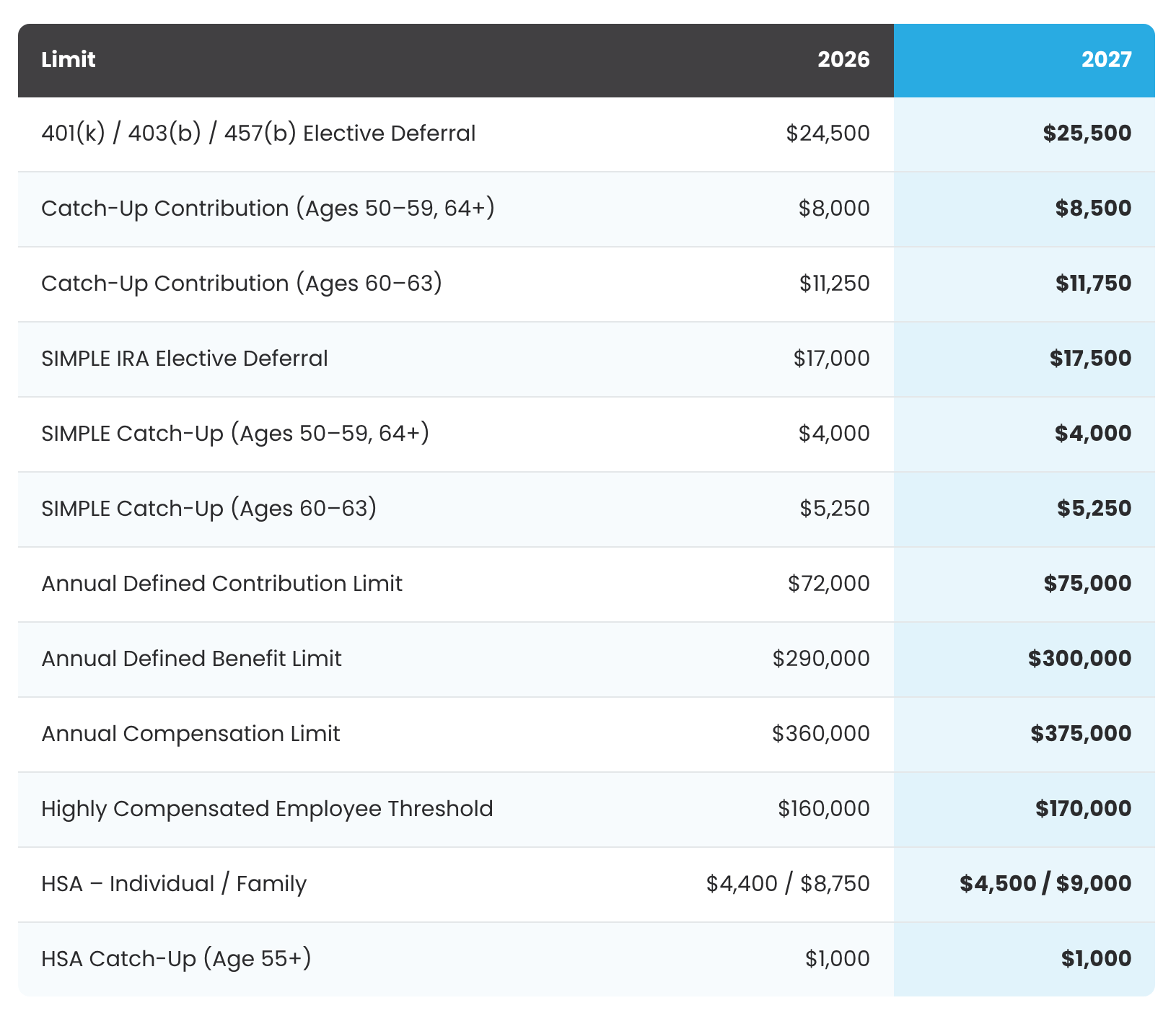
Source: IRS Notice 2026-66 (issued November 12, 2026) and Rev. Proc. 2026-24 (HSA limits).
A few of 2027’s numbers come with a story behind them, not just a bigger figure.
The Roth catch-up rule keeps moving. Starting in 2026, SECURE 2.0 requires catch-up contributions from higher-paid employees to go in as Roth (after-tax) dollars instead of pre-tax. The test looks backward: your prior year’s FICA wages decide whether this year’s catch-up must be Roth. For 2027, that means anyone who earned more than $155,000 in FICA wages during 2026 will need to make their 2027 catch-up contributions as Roth. The rule covers 401(k), 403(b), and governmental 457(b) plans — it doesn’t reach SIMPLE IRAs or SEPs.
Some SIMPLE catch-ups are holding steady. The standard SIMPLE catch-up ($4,000), the age 60–63 catch-up ($5,250), and the higher-limit-plan catch-up ($3,850) all carry over unchanged from 2026.
HSA limits climb too, even though they come from a separate IRS revenue procedure rather than the cost-of-living notice. Self-only coverage rises to $4,500 and family coverage to $9,000; the 55+ catch-up holds at its long-standing $1,000.
For years, lower- and middle-income savers who contributed to a retirement plan or IRA could claim the Saver’s Credit — a nonrefundable tax credit worth up to $1,000 ($2,000 if married filing jointly). 2026 is the Saver’s Credit’s last year, except for contributions to ABLE accounts, which keep the credit afterward.
Starting with tax year 2027, the Saver’s Match (IRC §6433) takes its place. Instead of a credit claimed at tax time, the government deposits a 50% match — up to $1,000 per person — directly into the saver’s retirement account. The income test changes too: eligibility runs on Modified Adjusted Gross Income (MAGI), which adds back pre-tax retirement deferrals and deductible IRA contributions, rather than lowering AGI the way the old credit did. For a married couple filing jointly, the full 50% match applies up to $41,000 in MAGI for 2027, phasing out above $71,000.
It’s a meaningful shift for plan sponsors with lower-wage workforces: eligible employees get the incentive automatically, deposited where it can keep growing, instead of waiting on a tax refund.
New numbers only help if your plan documents, payroll system, and employee communications reflect them. If you’re not sure how the 2027 limits affect your specific plan design — or what the Saver’s Match means for your workforce — we’re here to help you sort through it in plain English.
Reach your My Benefits team any time at Sales@MyBenefits.me or 678.212.5782. We bring it all together for you.
Your retirement plan questions answered, in plain English, by an expert. Use the form below to ask our retirement plan experts your question.